

Roughly 40-60% of people treated for addiction relapse at some point. When it’s said like that, it sounds more like a verdict on willpower, on character, on how badly someone actually wanted to get better.
But then take a look at relapse rates for chronic diseases nobody even moralizes about. Type 1 diabetes sits at 30-50%. Hypertension and asthma both run 50-70%. Addiction’s numbers land smack down the middle of that range, not as some special case of moral failure, but as an ordinary chronic condition simply doing what chronic conditions do.
The pathway that’s getting hijacked…
Reward in the brain runs through a specific circuit. It’s not some vague feeling that’s scattered everywhere. The ventral tegmental area (VTA), a small region in the midbrain, releases dopamine into the nucleus accumbens (NAcc), which translates that signal into motivation and pursuit. The prefrontal cortex, meanwhile, sits above both of these structures, weighing whether chasing a given reward is actually a good idea in the current situation. Addictive substances and behaviors do not create a new circuit in the brain. They hijack this one, the same pathway that evolved to make food, water, and sex feel worth pursuing, and flood it with a dopamine signal far larger than anything the system was built to process.
Wanting vs. Liking
The pleasure from a drug and the craving for a drug are not the same signal, and over time they move in completely opposite directions.
Early on, tolerance sets in and the actual high—the liking—gets smaller with repeated use. The brain adapts to the flood of dopamine by scaling back its own sensitivity, so the same dose delivers less of a payoff than it used to.
The wanting does the opposite. Researchers call this incentive sensitization: the circuitry that drives craving becomes more reactive over time, not less, even as the reward itself keeps shrinking. Someone deep into addiction can end up chasing a high they no longer really enjoy, driven by a wanting system running much hotter than the reward it’s chasing.
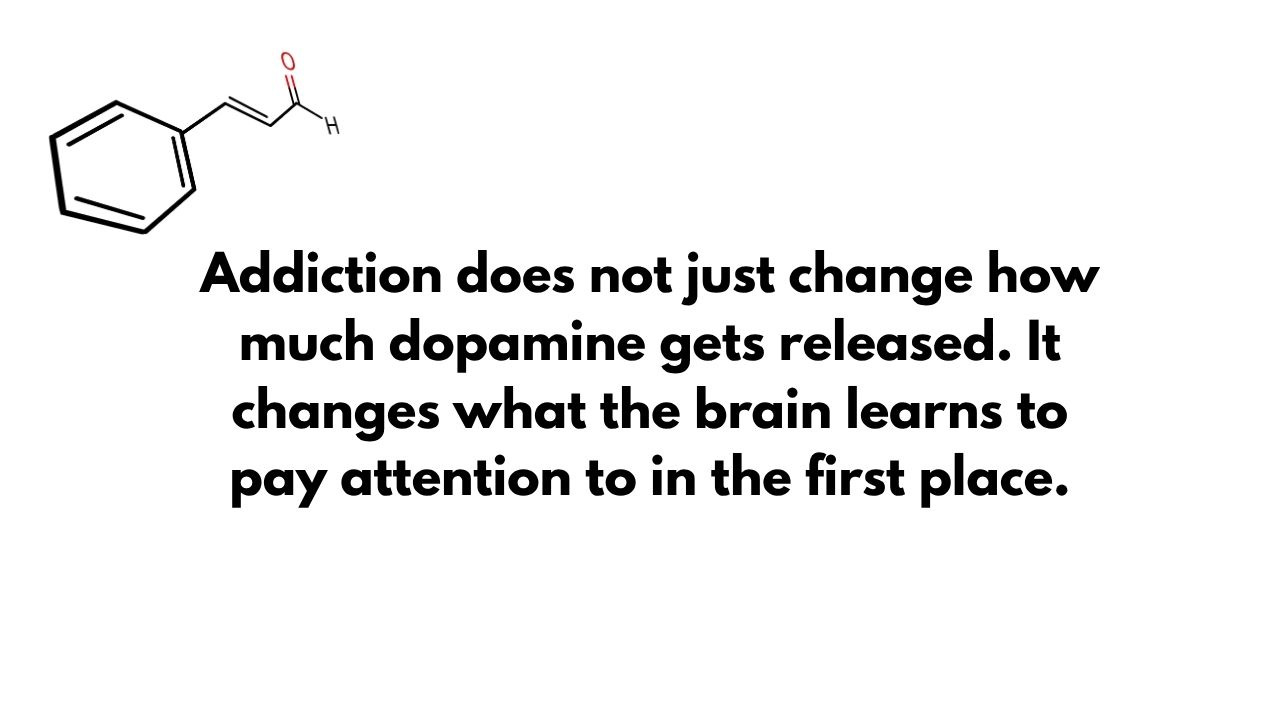
The same circuitry that once flagged important things like food, danger, or a potential mate, starts tagging drug-related cues as urgent too. A specific street. A certain time of day. A person, a smell…even just a mood. Over repeated exposure, those cues stop being neutral background noise and start triggering a measurable craving response on their own, sometimes strong enough to override an intention formed hours earlier in a completely different state of mind.
This is a big part of why environment matters so much in recovery, and why it is not a character issue that someone struggles more in the exact places they used to use. Their brain built actual, physical associations there…the same category of associations that let you remember exactly where you parked or flinch at a sound tied to a bad memory.
Those pathways do not just disappear because someone decided to stop.
Why relapse is expected…not a failure
The prefrontal cortex, the part of the brain responsible for weighing long-term consequences against short-term impulses, takes some serious damage under chronic substance use. Its ability to override the reward system weakens precisely when it’s needed most, which helps explain why relapse often happens in the middle of states such as stress, isolation, or exhaustion rather than during calm, stable stretches.
This is where the chronic disease comparison matters the most, not as a comforting slogan but as a clinical fact.
A single lapse does not doom someone to full relapse on its own. What often does is what happens after: shame, secrecy, or the belief that one slip proves the whole effort was pointless. That belief, sometimes called the abstinence violation effect, can turn a single use into a full return to the old pattern faster than the substance itself does.
Treatment that targets the real neural circuitry that’s been affected by a substance, aiming to “unhijack” it, outperforms treatment that simply demands more discipline or willpower. Medication-assisted treatment can blunt craving directly at the receptor level for certain substances. Behavioural therapy retrains the learned associations between cues and craving instead of just asking someone to white-knuckle through them every time a trigger shows up.
Importantly, because relapse risk peaks during stress and isolation, ongoing support after the initial treatment period tends to track with meaningfully better long-term outcomes than a single stint followed by silence.
Final thoughts,
None of this makes the brain permanently broken. For a long time, medicine assumed the adult brain was static and not plastic, that whatever circuits you had by a certain age were the ones you were stuck with for good. Neuroplasticity overturned that assumption. The same capacity for change that let addiction take hold in the first place, that same physical rewiring, is what recovery runs on, just pointed in the other direction and given enough time to work. Of course, that plasticity does shrink somewhat with age, but it never fully closes.
Addiction is not something that only happens to people with some specific flaw baked in. It is something that any brain is capable of falling into, given the right chemistry and the right circumstances, which is exactly why the right response is less stigma and more attention to the actual neural mechanism at play.
Relapse rates that sit alongside diabetes and asthma are not proof that recovery doesn’t work. Instead, they serve as evidence that addiction is exactly what the research has been telling us: a chronic condition, not a character flaw, and one where the odds of recovery get meaningfully better with real treatment, real time, and with shame taken out of the equation.
— AB


