

This all began with a frustration I couldn’t shake.
Every fitness app I’d ever used (or really, tried to use) was obsessed with the same thing: more. More sets, more reps, more volume, more days in the gym. I get it. That’s the instinct. If you want to build muscle and get stronger, you train harder and fatigue yourself to the brink of injury. Simple.
Except it isn’t.
I kept running into this wall. Not physically, but intellectually. Because I’d spent enough time studying neuroscience to understand that the gym alone is not where gains actually happen. Muscle growth, strength adaptation, the neurological rewiring that makes you more coordinated and more powerful over time…it all happens during recovery. The workout is just the stimulus. Rest is where the body responds, rewires, and rebuilds stronger than before.
No app was treating it that way. So I decided to build one.
Here’s what I should tell you upfront: I am not a developer. I had never built an app before this. I had no idea what Swift looked like, what SwiftUI meant, or how Xcode even worked. I just had an idea I couldn’t let go of, and the stubborn belief that figuring it out was possible.
I’ve named the app SynaptiFit, alluding to its neuroscience-and-fitness theme.
The concept is straightforward. SynaptiFit is a workout tracker backed by neuroscientific principles. It is not just a logging tool, but something that actually thinks about the full training-recovery cycle together. It takes in a comprehensive set of data: exercise type, sets, reps, total volume, perceived effort, sleep quality. From that, it estimates neural fatigue and builds recommendations around it. When to push. When to pull back. When a deload isn’t optional anymore.
The Science
The neuroscientific piece is what makes it feel different to me. Here’s a snapshot of the neuroscience of all this:
Certain exercises tax your central nervous system far more than others. Five heavy sets of squats is not remotely the same demand as five sets of leg curls, even if the volume looks identical on paper. Heavy compound lifts carry a neural cost that isolation movements simply don’t.
SynaptiFit accounts for that.
It weights exercises by their neural load, tracks your perceived effort over time, and flags when you’re accumulating the kind of fatigue that leads to plateaus or worse.
The honest limitation, which I haven’t tried to hide: phones can’t directly measure CNS fatigue. That’s just the reality of current hardware. What SynaptiFit does is use indirect markers like training load over time, exercise type weighting, RPE (rate of perceived exertion) trends, and recovery inputs to estimate it. Think of it like a mechanic diagnosing engine stress without plugging in a computer. They can’t read the exact fault code, but they can read the mileage, how hard you’ve been driving, and how long it’s been running without a rest. The estimate gets you there.
Future versions will close that gap with wearable integration, HRV data, and sleep stage analysis. But for now, the foundation is what I’m focused on building.
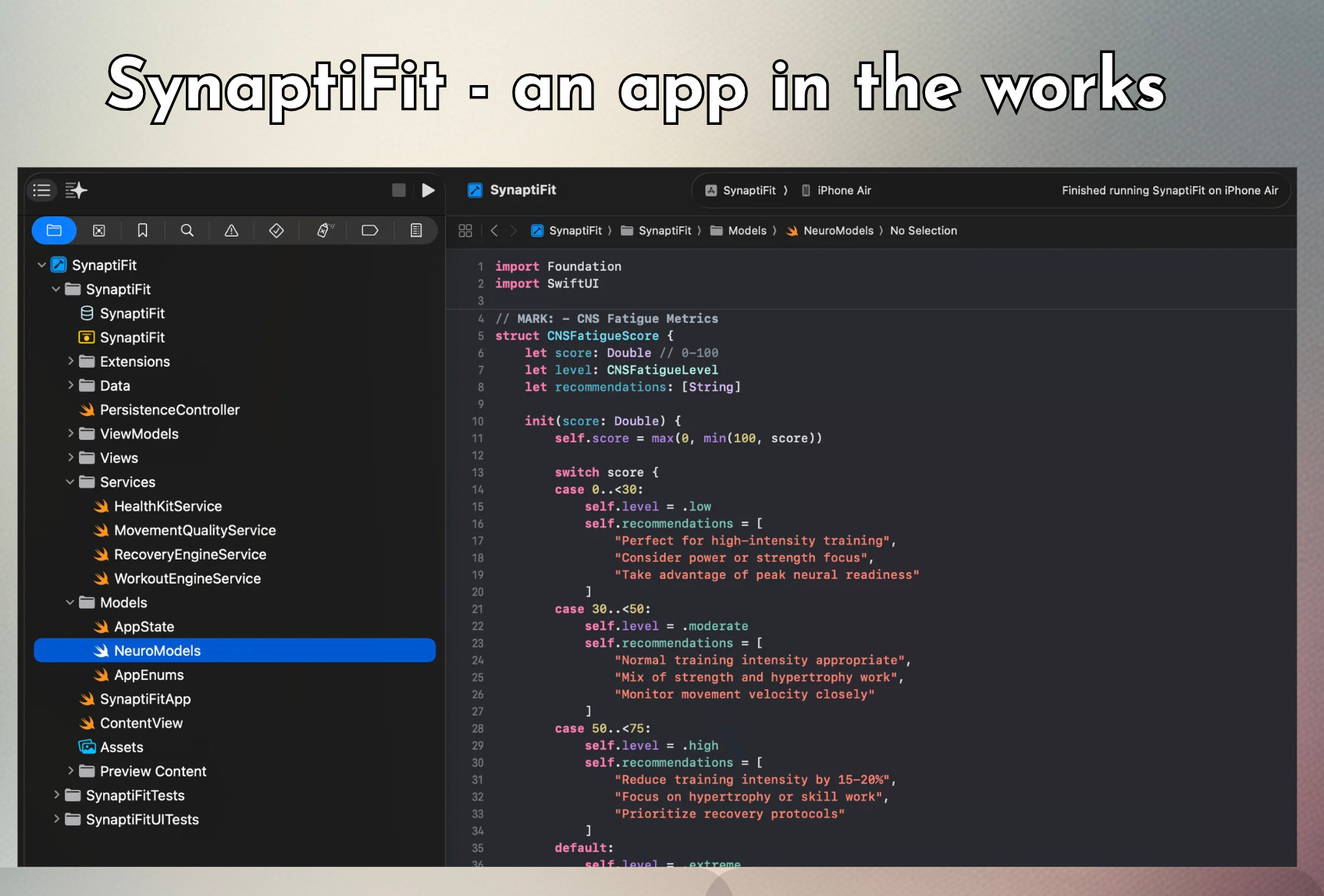
My experience so far, in a nutshell
Building this has been one of the harder things I’ve done recently. I say that without any drama.
I’m not the best at coding, so vibecoding made much of it possible. I won’t pretend otherwise. But possible doesn’t mean easy. Every solution surfaced a new error, and every error required a new solution. There were stretches where I’d fix something in one part of the app and watch something else break, and I’d sit there trying to figure out what I’d just done, trying to revert things instinctively but then of course the original error would return.
Yeah, Xcode has a way of humbling you.
What surprised me was how much of the challenge wasn’t technical at all. It was strategic. How do you structure a service architecture for something this layered? How do you build a recovery engine that’s flexible enough to account for all the variables that affect how someone feels on a given day? How do you communicate complex training science in a way that’s actually useful inside an app that people would use daily, not just in a textbook?
Those questions pushed me way more than the code did.
Why I chose to do this
A big reason for choosing to do this project specifically was not just that it combines two of my biggest passions—neuroscience and fitness—but also that I hadn’t ever done something like it before.
I had other ideas in mind…things I’d touched in some form, projects that felt safer. I ignored them. I wanted to build something I was genuinely clueless about. Something that would be more challenging, but that I would learn a lot more from.
That was the whole point.
There’s something that happens when you commit to working on something outside your competency. The learning is more uncomfortable, but it sticks differently. I now have a much better understanding of how an iOS app is actually structured. What it takes to handle local data storage, HealthKit integration, a modular service layer that can scale as features are added. I know these things because I had to fight through them, not because I read about them. None of it was prepared or studied beforehand. I just dived into this endeavour, made mistakes (still making them) and learned with every step.
But it’s the softer stuff that I might be taking away most.
Resiliency isn’t a word I used to think much about in this context. It sounds abstract. After a few weeks of iterating through Xcode errors, it stops sounding abstract. It starts to feel like a muscle.
One that gets trained the same way everything else does: under repeated stress, with enough recovery to come back stronger.
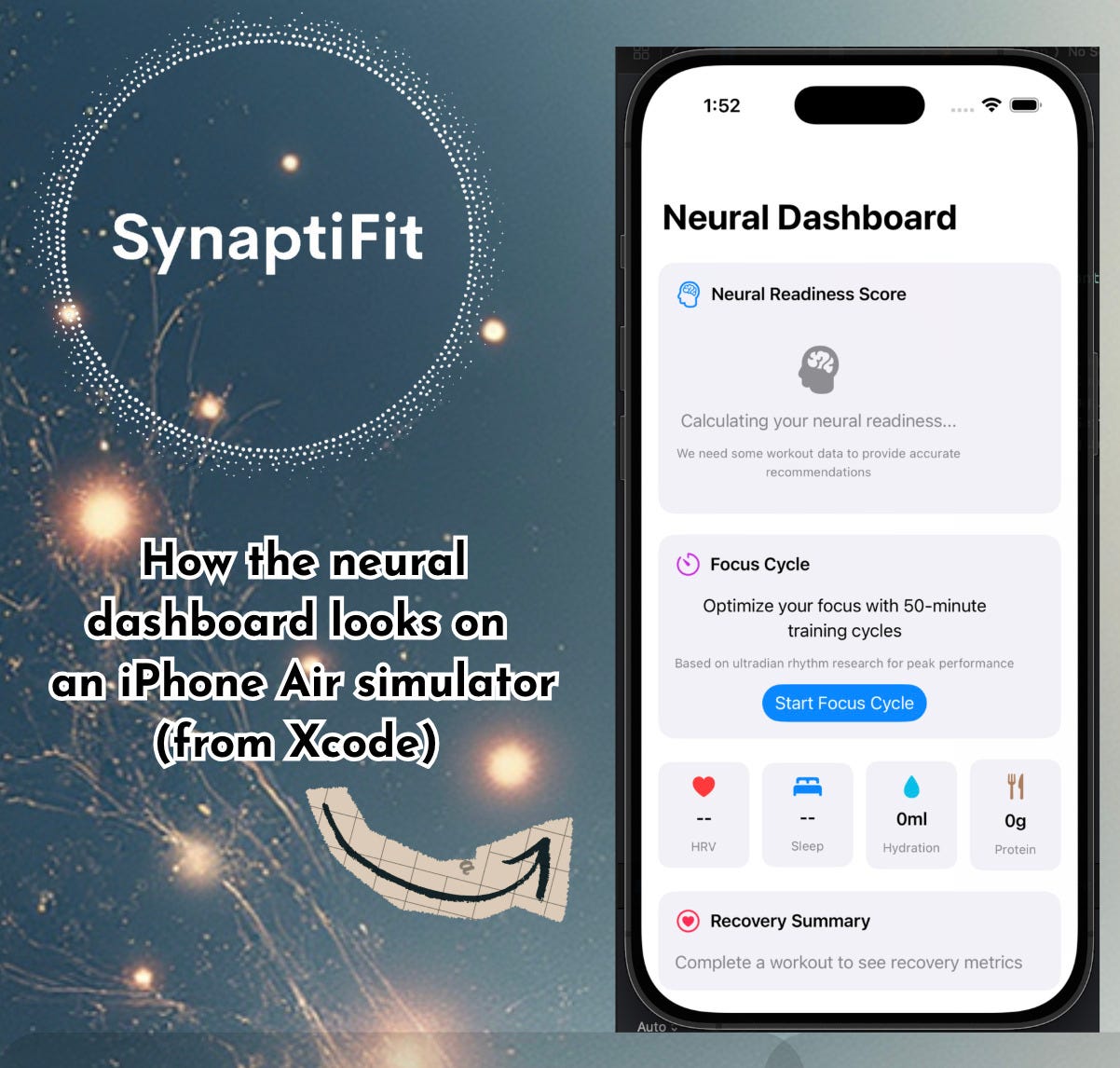
SynaptiFit is not anywhere near finished. I want to be clear about that. I started working on the app in October 2025 and originally planned to have it ready by this summer.
It works in the simulator. The core architecture is in place. But there is still real work ahead (including a lot of errors to fix) before it lands on the App Store and will be ready for you to use.
I’m not in a rush to pretend otherwise. Besides, doing more research on neural fatigue/recovery/science-based lifting and learning more about app building itself won’t hurt and will only be worth the time to delay the launch of the app, ensuring it’s functional enough and all grounded in strong evidence.
What I know is that this project came from a real place: two things I genuinely care about, neuroscience and lifting weights, colliding into something that felt worth building. That hasn’t changed. If anything, the difficulty has made me more attached to it, not less. That is something that will continue to push me as I make this app come to life.
SynaptiFit will be published soon, and when it is, I’ll immediately let you know (yes immediately. I’ll be too excited not to).
I will post an announcement. Perhaps another Substack article ;)
Until then, I’ll be in Xcode.
Amazig project ro, keep doing it :)