

Earlier this month, I got a text from Navneeth Badhri.
He’s the Founder of NeuroSpark, a student-led organization based in Washington state that aims to boost neuroscience education among middle-schoolers and high-schoolers through interactive, fun ways. Navneeth asked me to be a guest speaker at NeuroSpark’s annual brain bee for middle-schoolers: the Junior NeuroBee. This is something I could not say no to, because like him, I believe that educating the next generation of students and future leaders is one of the most important things we can do. So, of course I said yes, and ended up giving a talk at their 2026 Junior NeuroBee on Saturday, October 17, about my path into neuroscience, the ups and downs of it, my research, and why I think more people should become involved with neuroscience in the next generation.
The event consisted of a written round, a verbal final round, and a guest speaker talk in between, during which I gave the speech. I had planned to keep it short and it ran way over, as I originally aimed for 30 minutes but ended up speaking for 80. Probably the longest talk I’ve given, and totally worth it although unplanned. Afterward, I stayed on as a judge for the final round, where the participants were answering questions about the precentral gyrus, the nodes of Ranvier and the sort in under twenty seconds, which is more than I could have done at their age. Very impressive.
Here are six things I told them, and what I’d say to anyone at a young age thinking about going into neuroscience.
So why neuroscience? Where my passion came from…
I chose neuroscience for four main reasons, and the first one came first.
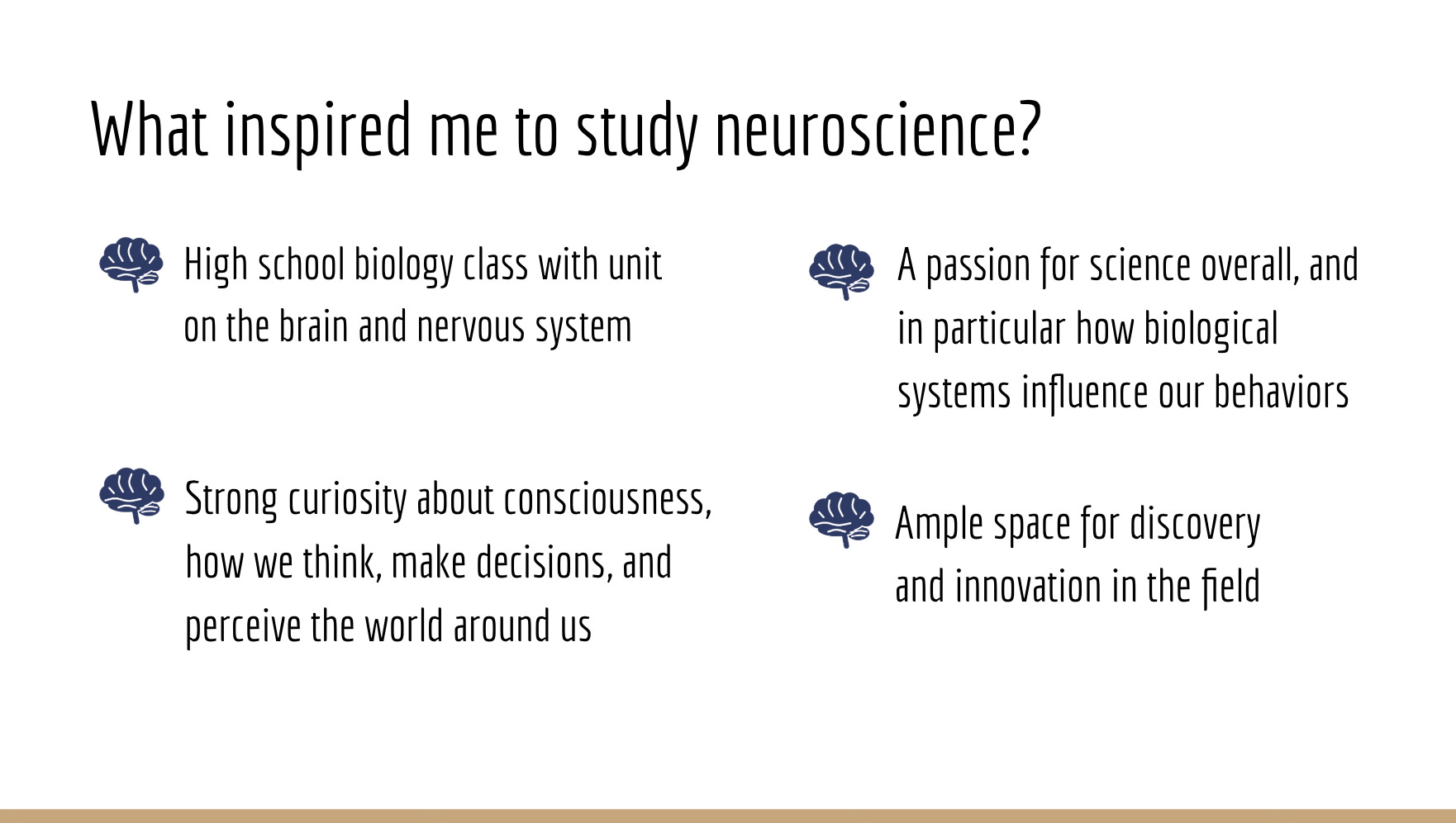
In high school, my biology class had a unit on the brain and nervous system, and I was fascinated that one incredibly intricate system could produce things we still haven’t fully made sense of, such as consciousness, decision-making, and planning for a future that doesn’t exist yet. If a unit like that is coming up in your classes, pay attention to how it makes you feel, because sometimes one unit is all it takes to flip a switch in your mind.
That fascination became my second reason: a pull toward consciousness in particular. Right now, your brain is turning sound from this speech recording, light, and everything around you into a single experience that feels like you, and nobody has been able to fully explain how. You and a friend can look at the same colour, but neither of you can show the other what it looks like inside your head. This alone is a reason for fascination in neuroscience, at the very least.
Third, I love how biological systems shape behaviour. Why do you get nervous before a test? Why can one song change your whole mood? Those are biology questions, and the answers lie in the cells, chemicals, and electrical signals that turn biochemical processes into feelings and actions.
Fourth, the field is wide open for discovery and innovation. We’ve learned a lot about the brain, but medicine still can’t cure many brain diseases, and scientists are still working out how memories are stored, why we sleep, and how the brain heals after an injury. If you like having something to work on, that’s a great thing, because as far as we can see, the quest for further discovery and innovation in neuroscience may never end.
The list of reasons continues, but these are my four main ones.
The gaps keep shrinking
This was my favourite slides from my slideshow, very fun to make and informative as I got to look back on some of the most significant events that have shaped neuroscience with the decreasing time intervals between them.
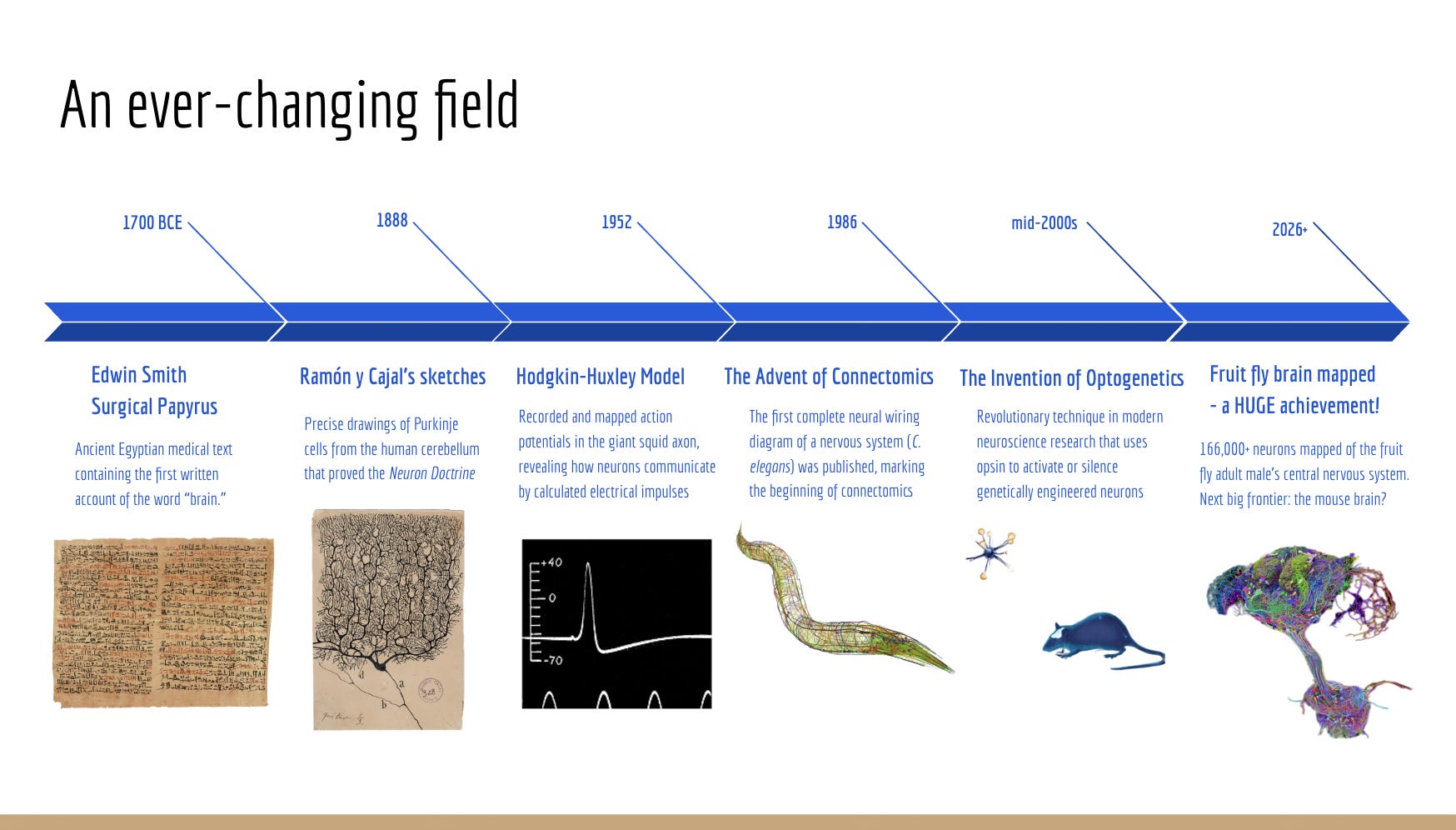
In 1986 we mapped every connection in the nervous system of C. elegans, a worm with only 302 neurons—a huge achievement at the time. This past June, a team completed the connectome of the entire central nervous system of an adult male fruit fly…more than 166,000 neurons! Forty years from 302 to 166,000 is a MASSIVE jump.
What’s more intriguing and can be seen in the timeline above: the intervals between major milestones in neuroscience went from around 3,600 years to 64 to 34 to about 20, and they keep getting shorter, because every new tool makes the next discovery faster. Optogenetics is a great example. Before it, we mostly used electrodes, which can record general neural activity but can’t tell you which specific types of neurons that activity is coming from. Now you can switch a specific group of cells on and off with light and test whether they cause a particular behavior instead of having to guess. The next big target is the mouse brain, which has 78 million neurons, and based on work out of the Allen Institute in Seattle, it could be mapped in the next 10 to 15 years. Until only a few years ago, most people figured we’d never see that happen in our lifetime. A student who starts in the field now could witness several significant moments like that over a career. I find that absurd, in the most exciting way. The thought that we could potentially even see the entire human brain mapped in our lifetime at the rate that technology, imaging techniques, and teams of scientists are growing is mindblowing. But it could very much happen.
My path
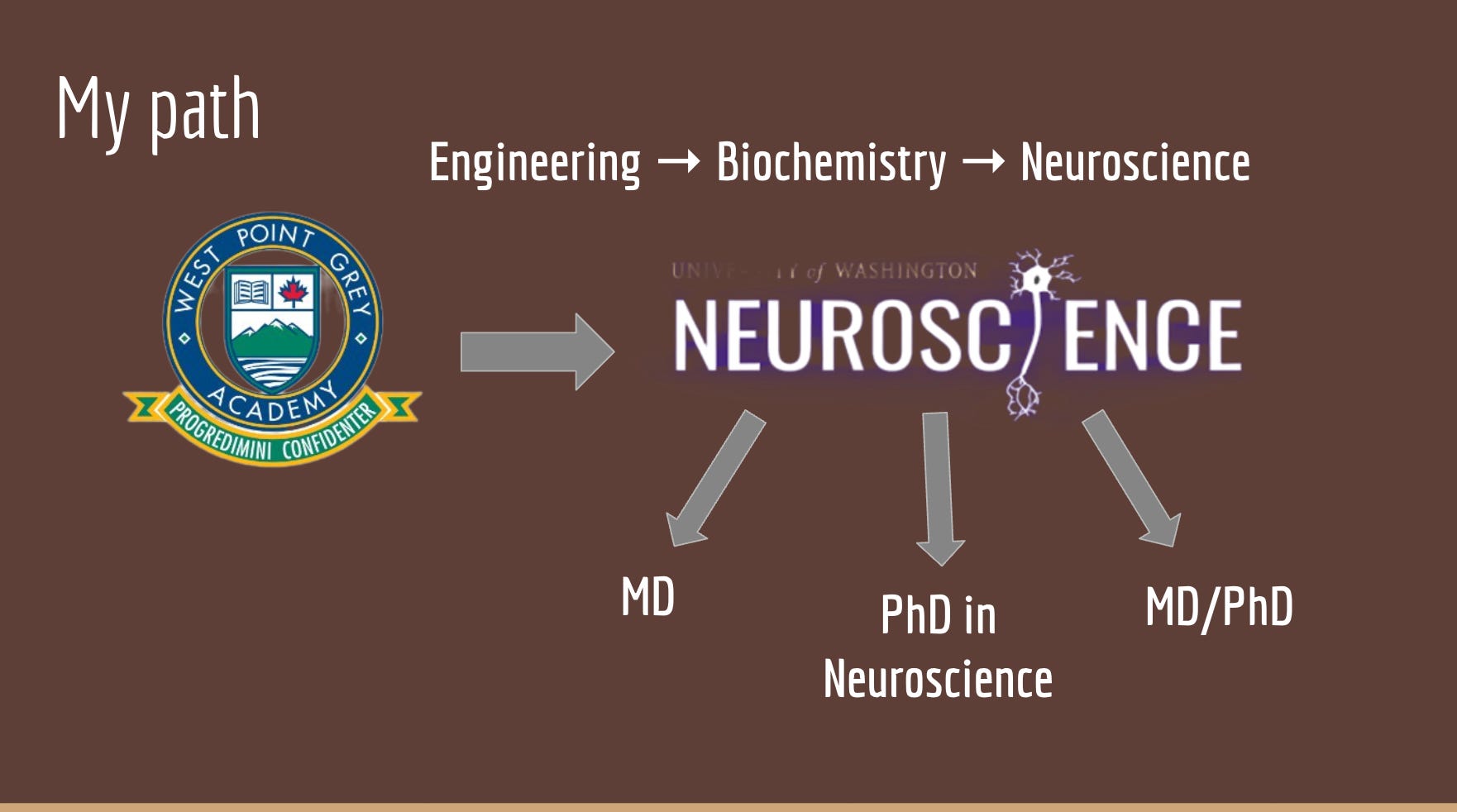
I didn’t always have an interest in neuroscience. In elementary school I was into math, Minecraft, and Lego, so basically an obsession with how pieces fit together…and that pointed me towards engineering. Early in high school it turned into biochemistry as my interest in biology, chemistry, and human physiology grew, and then the nervous system unit in my bio class seemingly pulled everything together.
Looking back now, each field gave me something: engineering gave me the habit of building things, biochemistry gave me the interest in molecules and how they run biological systems, and neuroscience gave me a reason to use both—and a lot more. The research I do now in the Elbert Lab is in a sense just engineering applied to biology. You build a model, then figure out why it behaves the way it does, and obtain results from it. In deciding where to pursue neuroscience, I ended up at UW partly for the incredible research and faculty, partly because it’s close to home in Vancouver, and partly because the Allen Institute + many other world-class institutions are nearby in the Seattle area, which matters a lot if you’re a local student who wants to get involved early.
Building virtual patients
I do research at the Elbert Lab, part of UW Neurology (more on that here and here), where we study Alzheimer’s disease through virtual patients. One of the most important things to understand about the disease—an underlying concept for a lot of the research on it—is that it starts quietly. Amyloid-beta, a sticky protein everyone has inside their brain, builds up into plaques more than ten years before the first symptom appears, so by the time someone is diagnosed the disease has been running for years, like a slow roof leak where the water’s been getting in long before you see the stain.
The problem isn’t that amyloid-beta exists of course, since we all have that naturally. It’s whether your brain clears it fast enough, and that job belongs to microglia, the brain’s resident immune cells. APOE4, the most common genetic risk factor for late-onset Alzheimer’s, impairs the ability of microglia to clear out waste efficiently. APOE4 does raise your risk but does not guarantee anything. What I’ve done as part of my research was build virtual patients, with one group consisting of APOE4 carriers and the other group consisting of non-carriers, simulating real patients. Except, instead of real people, these virtual patients are made out of math and python code, trained on true data from PET scans (which show amyloid-beta levels in a living brain) and measurements of cerebrospinal fluid—the fluid around your brain and spinal cord.
Training one felt like tuning a guitar: change a setting, run it, compare it to the real data, adjust, repeat. I’ve had people ask why I don’t use real patients and create virtual patients instead, and the answer is that Alzheimer’s moves so slowly that testing it in real people means following them for decades as part of longitudinal studies. That is possible, but is incredibly lengthy and expensive to do.
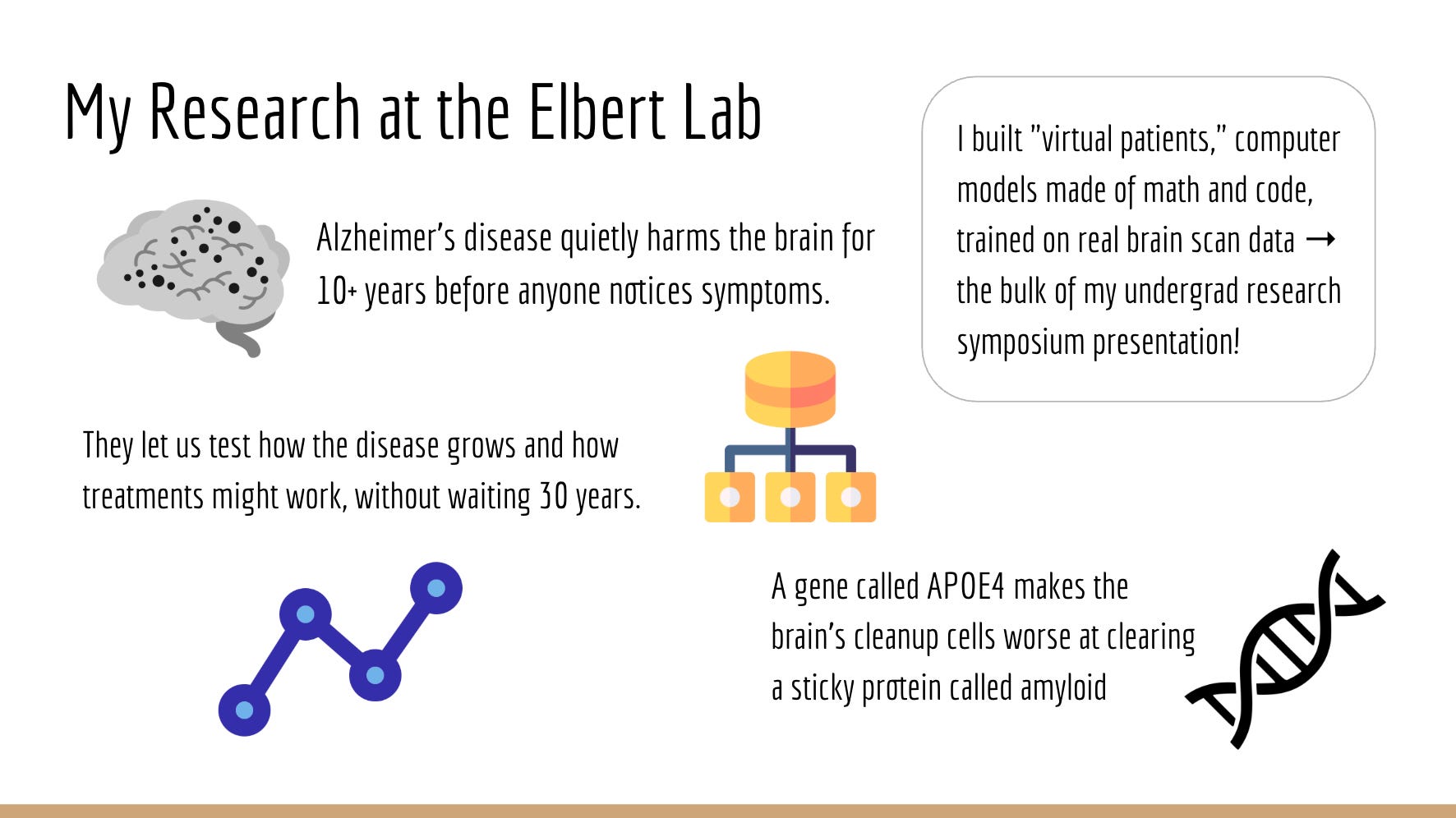
A virtual patient is essentially a flight simulator for Alzheimer’s, and you can change one variable at a time to experiment with how different factors play into the trajectory of the disease—something you can’t do with a human being. The model is still very much a work in progress, however. It only changes how well microglia clear amyloid-beta between the two groups, and I haven’t added tau yet, which is another major player in Alzheimer’s disease. At the UW Undergraduate Research Symposium in May this year, someone asked me why I didn’t vary production or clumping of the amyloid-beta proteins too, and I could answer because of the sensitivity analyses I’d run as part of my research.
The key takeaway from this that I wanted the students to understand is that if you can explain your choices out loud to someone who’s challenging them, you understand your work, and if you can’t, you find out fast that there are gaps to be filled in your understanding.
That was probably the most eye-opening part of the symposium for me, and one of the many reasons I will do it again in 2027.
You’re going to fail inevitably
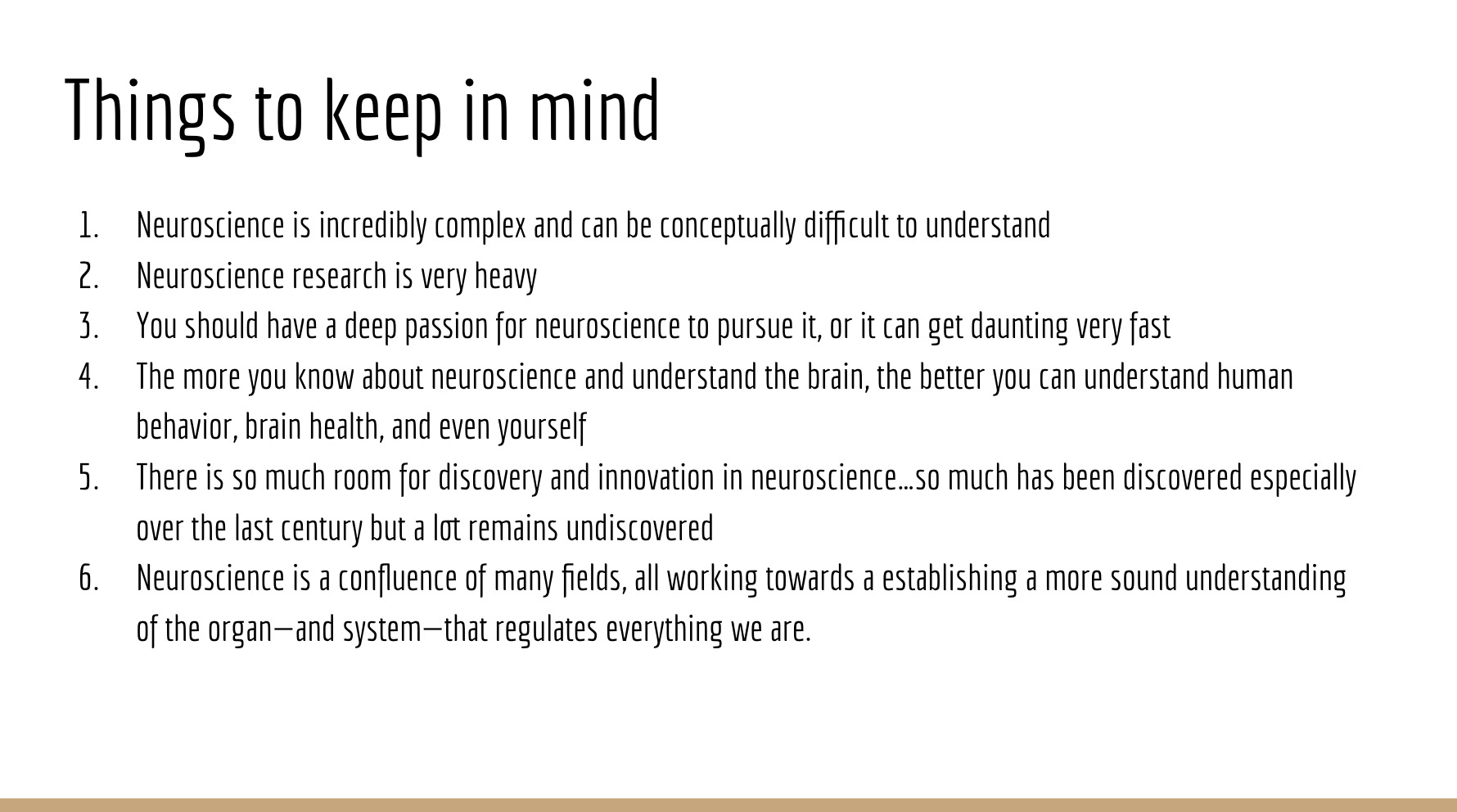
The virtual patient model did not match the real data a ridiculous number of times. The tempting move was to give up on the approach entirely, but the better move was to return to my assumptions and find what went wrong. I made the students write this part down to understand it fully and alter any false expectations they might’ve had: you will fail in research, absolutely, and a bad result is still information. Repeating experiments and doing things differently is a natural part of the process. Neuroscience is also heavy in a different way, because such diseases do seriously affect real people and real families, and you have to care enough to keep going when it gets daunting. Don’t go into this field just because it sounds cool or because you’re vaguely interested in the brain.
What to do as a middle-schooler
A few of the students asked how to get a head start when you obviously can’t run a lab at twelve. My answer was to reach out to people as much as you can, and I think that’s underrated.
Cold email a professor at a local college, message someone at the Allen Institute, ask your teachers if they know any neuroscientists they could connect you with. Say who you are, say what you’re curious about, what intrigues you about their work/research, and ask one clear question, because short and concise messages get answered way more often than long ones. Most researchers love talking about their work, especially to a young person who really is interested in it. I wish I’d done this more in high school, because I think I’d be a lot more connected today. Beyond that, read stuff that’s a little over your head, write down one question after everything you read so you always have something to chase, and look for programs like the NeuroBee, science clubs, and events like Brain Awareness Week.
There are many ways to get involved in this beautiful field, even at a young age. So go for it.
Three things to remember to wrap it all up…
If anyone who watches this—especially younger students who are still trying to figure out if they’re passionate about neuroscience or not—only remember three things from my talk, here they are:
1) Start with what you’re curious about
2) You don’t need your whole path figured out (I’ve changed direction twice to get here myself)
3) A result that doesn’t work is still a result you can learn from. This final piece of advice is one of the biggest things that research has taught me so far.
It was eye-opening to see how passionate these students were about the brain at such a young age, and I hope my talk inspired them to engage more deeply with it.
Thank you Navneeth for inviting me to speak at this wonderful event, to everyone who attended, and to the entire NeuroSpark team for having me. Hope to speak at another one of your events soon!
You can watch the recording of my talk above and the full slideshow here.

